
This lesson introduces you to the essential aspects of cloud security. We will discuss common security challenges in the cloud and best practices to mitigate risks. Topics include data protection, identity management, and compliance, ensuring you understand how to maintain security in cloud environments.
1. What is Cloud Security?
Cloud security refers to the set of policies, controls, technologies, and procedures designed to protect data, applications, and infrastructure in cloud environments. It ensures:
🔹 Confidentiality – Protecting sensitive information from unauthorized access.
🔹 Integrity – Ensuring data is accurate and has not been altered.
🔹 Availability – Keeping cloud resources accessible when needed.
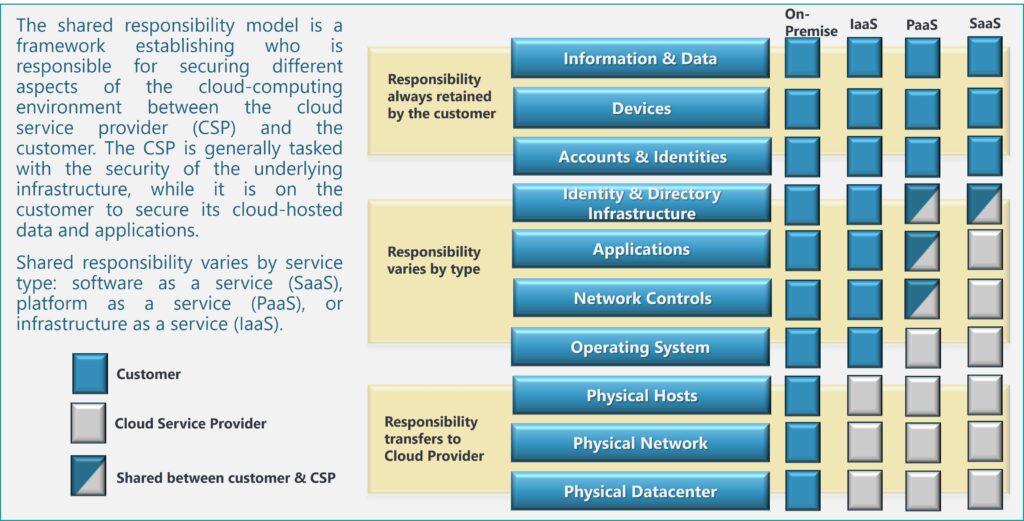
Cloud security is a shared responsibility between the cloud provider and the customer, often following a Shared Responsibility Model.
Shared Responsibility Model
2. Common Cloud Security Threats & Risks
Despite its benefits, cloud computing comes with security risks. The most common threats include:
🔴 Data Breaches
Unauthorized access to sensitive data due to misconfigured security settings or weak access controls.
✅ Prevention: Encrypt data, enforce access controls, and use Multi-Factor Authentication (MFA).
🔴 Misconfiguration
Improper cloud settings can expose data or make systems vulnerable to attacks.
✅ Prevention: Regular security audits, automated configuration checks, and compliance monitoring.
🔴 Insider Threats
Employees or contractors misusing access to leak or manipulate data.
✅ Prevention: Use least privilege access, monitor user activities, and implement logging.
🔴 Distributed Denial of Service (DDoS) Attacks
Cybercriminals flood cloud services with excessive requests, making them unavailable.
✅ Prevention: Use firewalls, anti-DDoS protection, and auto-scaling to mitigate attacks.
🔴 Insecure APIs
Poorly secured APIs can be exploited by attackers to gain unauthorized access.
✅ Prevention: Use API gateways, authentication (OAuth, JWT), and input validation.
🔴 Account Hijacking
Cybercriminals steal credentials and gain unauthorized access to cloud services.
✅ Prevention: Use strong passwords, MFA, and monitor account activity.
3. Best Practices for Cloud Security
✅ 1. Identity and Access Management (IAM)
🔹 Implement role-based access control (RBAC) – Grant users the minimum required permissions.
🔹 Enable Multi-Factor Authentication (MFA) to prevent unauthorized logins.
🔹 Use Zero Trust Architecture (ZTA) – Assume no user or device is trusted by default.
✅ 2. Data Encryption
🔹 Encrypt data at rest (stored data) and data in transit (moving data).
🔹 Use cloud provider encryption services (AWS KMS, Azure Key Vault, Google Cloud KMS).
🔹 Rotate encryption keys regularly.
✅ 3. Secure Network Architecture
🔹 Implement Virtual Private Cloud (VPC) and firewalls to restrict access.
🔹 Use network segmentation to isolate sensitive data and applications.
🔹 Monitor network traffic with Intrusion Detection and Prevention Systems (IDS/IPS).
✅ 4. Regular Security Audits & Compliance Checks
🔹 Perform vulnerability assessments and penetration testing (VAPT).
🔹 Use cloud security posture management (CSPM) tools to detect misconfigurations.
🔹 Ensure compliance with security standards like ISO 27001, SOC 2, GDPR, HIPAA.
✅ 5. Backup & Disaster Recovery
🔹 Set up automated backups and ensure redundancy across multiple cloud regions.
🔹 Use disaster recovery plans (DRP) to quickly restore services during failures.
🔹 Regularly test backup integrity and restore processes.
4. Cloud Security Tools & Technologies
Organizations use various tools to secure cloud environments.
| Security Tool | Purpose | Examples |
|---|---|---|
| Identity & Access Management (IAM) | Manage user roles, permissions, and authentication. | AWS IAM, Azure Active Directory (Entra ID), Okta |
| Cloud Security Posture Management (CSPM) | Detect and fix misconfigurations in cloud environments. | Prisma Cloud, Microsoft Defender for Cloud |
| Security Information & Event Management (SIEM) | Collect and analyze security logs for threat detection. | Splunk, Wazuh, Microsoft Sentinel |
| Endpoint Security | Protect cloud-connected devices from malware. | Microsoft Defender for Endpoint, CrowdStrike |
| DDoS Protection | Prevents large-scale attacks that disrupt cloud services. | AWS Shield, Cloudflare, Azure DDoS Protection |
| Encryption & Key Management | Encrypts data and secures encryption keys. | AWS KMS, Google Cloud KMS, Azure Key Vault |
5. Compliance & Regulatory Standards in Cloud Security
Many industries have regulations that require strict cloud security measures.
| Regulation | Industry | Key Requirements |
|---|---|---|
| GDPR | Data Protection (EU) | Personal data protection, user consent, breach notification. |
| HIPAA | Healthcare (USA) | Protects patient health data (ePHI). |
| PCI-DSS | Payment Processing | Secure handling of credit card transactions. |
| ISO 27001 | General | Global standard for information security management. |
| SOC 2 | Cloud Service Providers | Data security, availability, and confidentiality. |
6. Cloud Security Case Studies
🔹 Case Study 1: Capital One Data Breach (2019)
🚨 A former AWS employee exploited a misconfigured firewall in Capital One’s AWS environment, exposing personal data of 100 million customers.
✅ Lesson: Regular security audits and firewall configurations are critical.
🔹 Case Study 2: Code Spaces Attack (2014)
🚨 Attackers gained access to AWS control panel and deleted all data, forcing Code Spaces to shut down.
✅ Lesson: MFA, backup strategies, and least privilege access are essential.
7. Summary & Key Takeaways
- Cloud security ensures confidentiality, integrity, and availability of cloud resources.
- The Shared Responsibility Model defines security roles between the provider and customer.
- Common threats include data breaches, misconfigurations, DDoS attacks, and insecure APIs.
- Best practices include IAM, encryption, network security, audits, and disaster recovery.
- Compliance standards like GDPR, HIPAA, PCI-DSS help ensure cloud security.